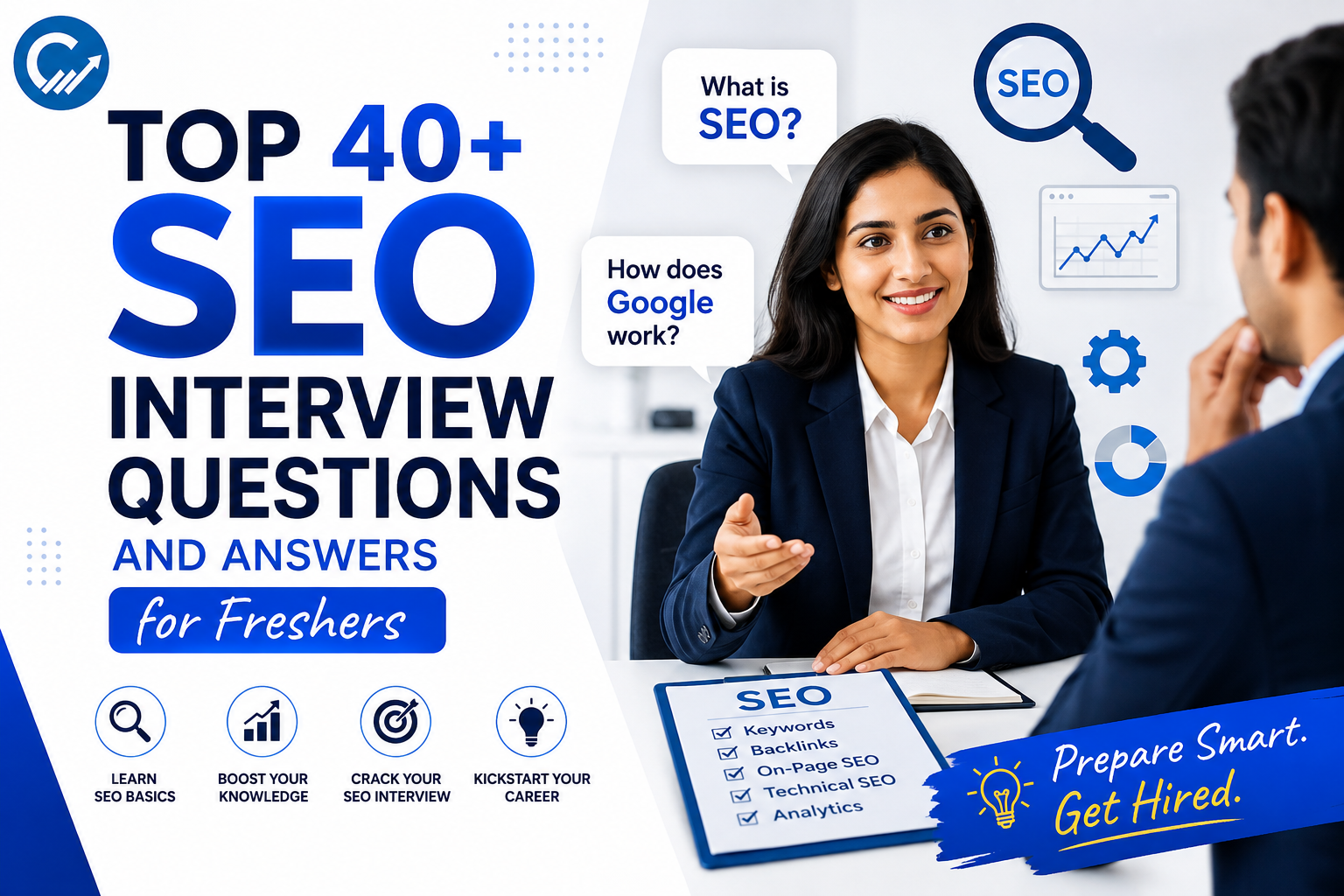
Top 40+ SEO Interview Questions and Answers for Freshers
Are you preparing for your first SEO job, internship, or digital marketing interview? This complete guide covers SEO interview questions that are commonly asked during interviews for freshers, beginners, interns, and entry-level SEO professionals.
If you are searching for SEO interview questions and answers, SEO interview questions for freshers, or SEO interview questions for beginners, this guide will help you understand the concepts you need to know before appearing for an interview.
SEO is one of the most important skills in digital marketing. From keyword research and on-page SEO to technical SEO, link building, Local SEO, Google Search Console, and analytics, an SEO professional needs both theoretical knowledge and practical understanding.
In this article, Code Academics covers 40+ SEO interview questions and answers, including basic, technical, on-page, off-page, Local SEO, and practical questions.
If you are looking for structured, practical SEO training, you can also explore our SEO course in Jalandhar.
Basic SEO Interview Questions
1. What is SEO?
SEO stands for Search Engine Optimization. It is the process of improving a website's visibility in organic search engine results.
The objective of SEO is to help search engines understand a website while providing useful and relevant content to users.
This is one of the most common SEO interview questions for freshers because understanding the basic definition of SEO is essential before learning advanced concepts.
2. How does SEO work?
Search engines discover webpages through crawling, process and organize information through indexing, and determine which results are most relevant for a user's search query.
SEO helps websites become easier to crawl, understand, and discover while creating useful content that satisfies search intent.
3. Why is SEO important for a business?
SEO can help businesses:
- Increase organic visibility
- Generate relevant website traffic
- Reach potential customers
- Build online credibility
- Generate leads
- Support long-term digital marketing growth
For an SEO executive, understanding the connection between rankings, traffic, leads, and business objectives is particularly important.
4. What are the different types of SEO?
The major types or areas of SEO include:
- On-page SEO
- Technical SEO
- Off-page SEO
- Local SEO
An SEO professional may work across all these areas depending on the website and business requirements.
5. What is organic traffic?
Organic traffic refers to visitors who reach a website through unpaid search engine results.
For example, someone searching for "SEO course in Jalandhar" and clicking an unpaid Google result generates organic search traffic.
6. What is SERP?
SERP stands for Search Engine Results Page.
It is the page displayed after a user enters a query into a search engine. A SERP may contain organic results, advertisements, local results, images, videos, featured snippets, and other search features.
7. What is a keyword in SEO?
A keyword is a word or phrase that a user enters into a search engine.
For example:
SEO course in Jalandhar
SEO interview questions for freshers
digital marketing course in Jalandhar
These queries represent different types of search intent.
8. What is keyword research?
Keyword research is the process of finding and analyzing search queries that users may enter into search engines.
An SEO professional considers relevance, search intent, competition, search demand, business value, and keyword variations when selecting keywords.
9. What are long-tail keywords?
Long-tail keywords are more specific search phrases, generally containing multiple words.
For example:
SEO interview questions for freshers in India
is a more specific query than simply:
SEO interview questions
Long-tail keywords can be valuable because they often indicate a clearer user requirement.
10. What is search intent?
Search intent refers to the reason why a person searches for something online.
Common types include:
- Informational intent
- Navigational intent
- Commercial intent
- Transactional intent
Understanding search intent is an important part of SEO interview preparation because SEO is not simply about inserting keywords into content.
On-Page SEO Interview Questions
11. What is on-page SEO?
On-page SEO involves optimizing elements within a webpage to improve its relevance, usability, and search visibility.
It includes content, headings, title tags, URLs, internal links, images, and other page elements.
12. What is a meta title?
A meta title is the title associated with a webpage that can appear in search engine results.
An effective title should clearly describe the page and be relevant to the user's search query.
13. What is a meta description?
A meta description is a short description of a webpage that may appear below its title in search results.
A good meta description should accurately summarize the page and encourage relevant users to click.
14. What is an H1 tag?
The H1 is commonly used as the primary heading of a webpage.
It should clearly communicate the main topic of the page and help users understand what they are going to read.
15. What is internal linking?
Internal linking means linking one page of a website to another page on the same website.
For example, an article about SEO interview questions can naturally link to Code Academics' SEO course page.
Internal links help users discover related content and help search engines understand the relationship between pages.
16. What is an SEO-friendly URL?
An SEO-friendly URL is short, descriptive, readable, and relevant to the page topic.
For example:
codeacademics.in/blog/seo-interview-questions
is easier to understand than a URL containing random numbers or characters.
17. What is image SEO?
Image SEO involves optimizing images for usability, accessibility, performance, and search understanding.
This may include descriptive file names, relevant alt text, appropriate dimensions, suitable formats, and proper placement.
18. What is alt text?
Alt text is descriptive text associated with an image.
It helps communicate what an image represents when it cannot be displayed and also supports accessibility.
19. What is duplicate content?
Duplicate content refers to substantially similar or identical content appearing in multiple locations.
When similar pages exist, search engines may need to determine which version is most appropriate for search results.
20. What is keyword cannibalization?
Keyword cannibalization can occur when multiple pages on the same website target very similar search intent.
An SEO professional should analyze competing pages and determine whether they need to be differentiated, consolidated, redirected, or otherwise improved.
Technical SEO Interview Questions
21. What is technical SEO?
Technical SEO focuses on improving the technical aspects of a website so search engines can crawl, understand, and index its content efficiently.
It can include crawlability, indexing, website architecture, redirects, canonicalization, mobile usability, page performance, and structured data.
22. What is crawling?
Crawling is the process through which search engine crawlers discover and access webpages.
Crawlers can discover URLs through links, sitemaps, and other mechanisms.
23. What is indexing?
Indexing is the process through which search engines process and store information about webpages they discover.
A webpage generally needs to be accessible and eligible for indexing before it can appear in organic search results.
24. What is robots.txt?
Robots.txt is a file that provides instructions to search engine crawlers about which areas of a website they may or may not crawl.
It needs to be configured carefully because preventing crawling does not automatically mean a URL can never appear in search results.
25. What is an XML sitemap?
An XML sitemap is a file that helps search engines discover important URLs on a website.
It can be particularly useful for larger websites and websites where some URLs may otherwise be difficult to discover.
26. What is a canonical URL?
A canonical URL indicates the preferred version of a webpage when multiple URLs contain similar or duplicate content.
Canonicalization helps search engines understand which URL should generally be considered the main version.
27. What is a 301 redirect?
A 301 redirect is generally used when a webpage has permanently moved from one URL to another.
It helps direct users and search engines to the new URL.
28. What is a 404 error?
A 404 error generally means that the requested webpage cannot be found.
SEO professionals should monitor important broken URLs and determine whether pages should be restored, redirected, or appropriately handled.
29. What are Core Web Vitals?
Core Web Vitals are metrics associated with aspects of webpage experience, including loading performance, responsiveness, and visual stability.
SEO professionals should understand how website performance can affect user experience.
30. What is mobile-first indexing?
Mobile-first indexing means Google primarily uses the mobile version of a website's content for indexing.
Therefore, websites should make sure their mobile version contains the important content and functionality available to users.
Off-Page SEO Interview Questions
31. What is off-page SEO?
Off-page SEO refers to activities and signals outside a website that can contribute to its visibility, reputation, authority, and discovery.
Link earning, digital PR, relevant mentions, and relationship building can form part of an off-page SEO strategy.
32. What is a backlink?
A backlink is a link from another website to your website.
For example, if another relevant educational website links to a useful Code Academics resource, that link is a backlink.
Quality, relevance, and context are more important than simply collecting a large number of links.
33. What is link building?
Link building is the process of earning or acquiring relevant links from other websites.
A good link-building strategy should focus on useful content, genuine relationships, relevance, and providing value to users.
34. What are do-follow and no-follow links?
These terms describe link attributes and how search engines may treat links.
A no-follow attribute provides an instruction indicating that the link should not pass certain ranking-related signals in the usual way.
An SEO professional should understand when different link attributes may be appropriate.
35. What is anchor text?
Anchor text is the clickable text used in a hyperlink.
For example:
could be used as anchor text for a relevant SEO training page.
Anchor text should be descriptive and natural rather than excessively repetitive.
Local SEO Interview Questions
36. What is Local SEO?
Local SEO focuses on improving a business's visibility for searches connected to a particular location.
Examples include:
- SEO classes in Jalandhar
- SEO course in Jalandhar
- Digital marketing institute in Jalandhar
- Digital marketing classes in Jalandhar
Local SEO is especially important for businesses that serve customers in specific cities or geographic areas.
37. What is Google Business Profile?
Google Business Profile is Google's platform for managing how eligible businesses appear across Google Search and Maps.
Businesses can provide information such as their name, address, phone number, business hours, services, photos, and reviews.
38. Why are reviews important for Local SEO?
Reviews can influence customer trust and help potential customers evaluate a local business.
Businesses should focus on delivering good customer experiences, earning genuine reviews, and responding professionally to customer feedback.
39. How can a business improve Local SEO?
A local business can improve its presence by:
- Maintaining accurate business information
- Optimizing its Google Business Profile
- Creating useful local content
- Earning relevant local mentions and links
- Maintaining consistent business information
- Encouraging genuine customer reviews
- Creating useful service and location pages
40. What is local keyword research?
Local keyword research involves identifying search queries that include or imply geographic intent.
For example:
SEO institute in Jalandhar
digital marketing course in Jalandhar
These keywords can be valuable for businesses that want to attract students or customers from a particular city.
Practical SEO Interview Questions
41. Which SEO tools should a fresher learn?
A beginner can start with:
- Google Search Console
- Google Analytics
- Google Keyword Planner
- Google Trends
- Google PageSpeed Insights
- Ahrefs
- Semrush
- Ubersuggest
Knowing the tools is useful, but understanding how to use them to solve actual SEO problems is more important.
42. How do you measure SEO success?
SEO performance can be measured through:
- Organic clicks
- Impressions
- Search queries
- Rankings
- Organic traffic
- Leads
- Conversions
- Revenue
- Engagement
For a business such as a training institute, qualified course enquiries and leads may be more valuable than traffic alone.
43. What is Google Search Console?
Google Search Console is a Google tool that helps website owners understand how their websites perform in Google Search.
It provides information about search queries, impressions, clicks, indexing, and various search-related issues.
44. What would you do if a website's organic traffic suddenly dropped?
First, I would identify when the traffic decline started and which pages and queries were affected.
Then I would investigate:
- Google Search Console data
- Analytics data
- Indexing problems
- Technical changes
- Website redesigns
- Content changes
- Search demand
- Seasonality
- Ranking changes
- Relevant search updates
The objective is to identify the actual cause before making major changes.
45. How would you optimize a webpage for a new keyword?
I would first understand the search intent behind the keyword.
Then I would analyze the type of content ranking for that query, create useful content that satisfies the user's need, optimize relevant titles and headings, improve internal linking, use keywords naturally, optimize images and technical elements, and monitor performance.
46. What is the difference between SEO and paid advertising?
SEO primarily focuses on earning organic visibility in search results.
Paid advertising involves paying for advertising placements.
Businesses can use both approaches as part of a wider digital marketing strategy.
47. Is SEO a good career for freshers?
Yes. SEO is a practical digital marketing skill used by agencies, startups, e-commerce companies, educational institutions, businesses, and other organizations.
Freshers can begin by learning keyword research, on-page SEO, Local SEO, content optimization, technical SEO basics, analytics, reporting, and commonly used SEO tools.
SEO Interview Preparation Tips for Freshers
Good SEO interview preparations should involve more than memorizing definitions.
Before attending an interview, make sure you understand:
- Keyword Research – Learn how to identify relevant keywords and understand search intent.
- On-Page SEO – Understand titles, headings, URLs, content optimization, images, and internal links.
- Technical SEO – Learn the basics of crawling, indexing, sitemaps, robots.txt, redirects, canonical URLs, and website performance.
- Off-Page SEO – Understand backlinks, anchor text, link building, and digital authority.
- Local SEO – Learn Google Business Profile, local keywords, reviews, and location-based optimization.
- SEO Tools – Get familiar with Google Search Console, Google Analytics, Keyword Planner, Google Trends, and commonly used SEO platforms.
- Practical SEO – Be ready to explain how you would handle a ranking drop, perform keyword research, optimize a page, or improve a website's organic visibility.
These areas can make your SEO interview preparation much more practical and effective.
Frequently Asked Questions About SEO Interviews
What are the most common SEO interview questions?
The most common questions generally cover SEO fundamentals, keyword research, on-page SEO, technical SEO, backlinks, Local SEO, analytics, and practical SEO scenarios.
What are SEO interview questions for freshers in India?
Freshers in India may be asked questions about basic SEO concepts, keyword research, on-page optimization, Google Search Console, backlinks, Local SEO, content optimization, and SEO tools.
What are SEO interview questions for internship candidates?
For internships, employers may focus on basic SEO understanding, keyword research, content optimization, search intent, Google tools, competitor analysis, and willingness to learn.
What are SEO interview questions for internship students?
Students applying for internships should prepare for questions around keyword research, on-page SEO, content writing, basic technical SEO, Google Search Console, backlinks, and how search engines work.
What are SEO interview questions for SEO executives?
For an SEO executive role, candidates may be asked more practical questions about keyword mapping, technical audits, backlinks, competitor analysis, Search Console, ranking drops, reporting, Local SEO, and SEO strategy.
What are SEO interview preparations that every fresher should follow?
Every fresher should understand the fundamentals, practice with real websites, learn commonly used SEO tools, understand search intent, and prepare examples of how they would solve practical SEO problems.
What is the difference between SEO and digital marketing?
SEO is one part of digital marketing. Digital marketing also includes paid advertising, social media marketing, email marketing, content marketing, analytics, and other online marketing channels.
If you want to develop SEO along with broader digital marketing skills, explore the Digital Marketing Course in Jalandhar at Code Academics.
Can I get an SEO job without a technical background?
Yes. You do not need to be an expert programmer to start learning SEO.
Beginners can start with keyword research, content optimization, on-page SEO, Local SEO, analytics, and Search Console before progressing into more technical areas.
How long does it take to learn SEO?
The fundamentals can be learned relatively quickly, but becoming job-ready requires consistent practice with real websites, projects, tools, and different SEO situations.
Is SEO a good career option for students?
SEO can be a useful career skill for students interested in digital marketing, content, online businesses, e-commerce, agencies, and performance marketing.
Build Practical SEO Skills with Code Academics
Reading SEO interview questions and answers is a good starting point, but practical experience is what helps you become confident in an actual SEO role.
At Code Academics, students can learn practical digital marketing skills through structured training and hands-on learning.
If your primary goal is SEO, explore our
SEO course in Jalandhar to build skills in areas such as keyword research, on-page SEO, off-page SEO, technical SEO, Local SEO, analytics, and SEO tools.
If you want to learn SEO along with Google Ads, Social Media Marketing, Email Marketing, Analytics, and other digital marketing skills, explore our
digital marketing course in Jalandhar.
Visit Code Academics in Jalandhar
If you are a student, fresher, job seeker, or aspiring digital marketer and want to discuss course options and career opportunities, you can visit us at:
Code Academics
SCO - 207, First Floor, Badwal Complex
Near Narinder Cinema, Jalandhar City
Phone: +91 9592 258 369
You can also visit our Code Academics website to explore our courses and training programs.
Whether you are preparing for an internship, your first SEO job, or a career in digital marketing, practical training can help you turn your knowledge into real-world skills.
Ready to start your SEO journey? Visit Code Academics in Jalandhar or call +91 9592 258 369 to discuss the right course for your career goals.